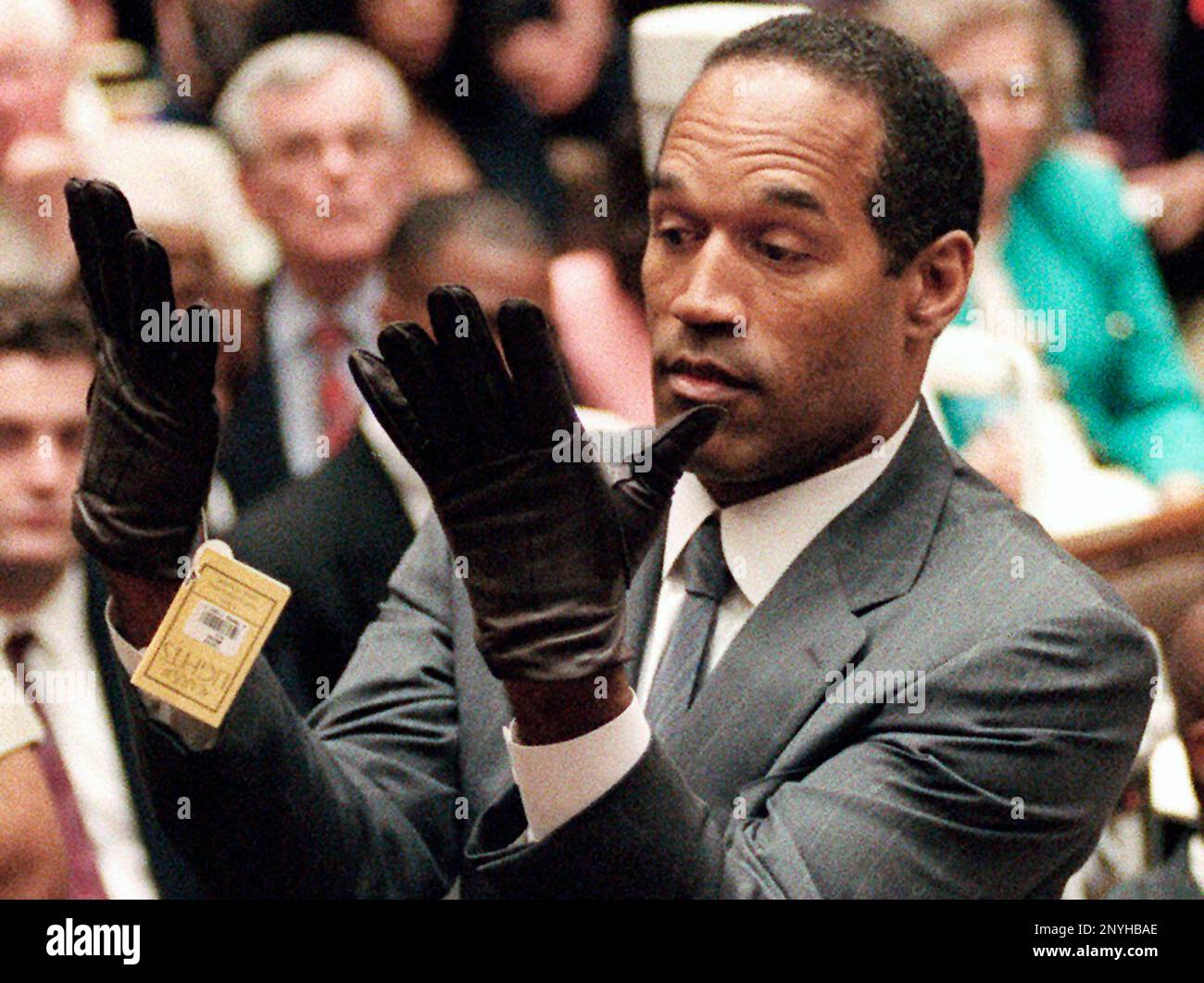
O.J. Simpson Glove Trial — The June 15, 1995 Demonstration

closedUSJune 12, 1994 — June 15, 1995

0 verified · 4 unverified · 4 claims total

On June 15, 1995, inside the Los Angeles Superior Court, prosecutor Christopher Darden made a decision that would reshape the trajectory of the most watched murder trial in American history. He asked O.J. Simpson to stand before the jury and try on a pair of bloody leather gloves — the same gloves prosecutors argued had been worn by a killer on the night Nicole Brown Simpson and Ron Goldman were stabbed to death outside Nicole's Brentwood home.

The gloves had been found the morning after the June 12, 1994 murders. One was recovered at Nicole Brown Simpson's residence at 875 South Bundy Drive in Brentwood; its match turned up at Simpson's Rockingham estate just miles away. Both were identified as Aris extra-fine leather gloves, saturated with blood that DNA analysis tied to both victims. The inside of the gloves, prosecutors maintained, also bore traces matching Simpson himself — placing his hands, they argued, inside the evidence.

For months, the prosecution had built its case around the gloves as the connective thread between crime scene and defendant. Since the night of the murders, however, the gloves had sat in storage — kept in paper bags rather than sealed containers. By the time of the demonstration fourteen months later, the defense would argue that this oversight mattered enormously.

On the morning of June 15, Darden believed the gloves would fit. He expected watching them slide onto Simpson's hands to settle any lingering questions in the jury's mind. What happened instead handed the defense one of the most indelible moments in courtroom history.

Simpson pulled a latex glove over his hands to simulate what a killer might have worn beneath the leather. Then he reached for the Aris gloves. He struggled. His fingers bulged against the seams. He flexed, strained, and the leather simply refused to close over his hands. The courtroom went quiet, then broke into murmurs. Jurors leaned forward. The demonstration was not going according to plan.

Defense lead attorney Johnnie Cochran was ready. In closing arguments, he distilled the moment to a single sentence that became the most quoted line in American courtroom history: "If it doesn't fit, you must acquit." The phrase was both a literal observation and a legal instruction — in a criminal trial, the prosecution must prove guilt beyond a reasonable doubt, and if the evidence cannot carry that weight, the jury is bound to acquit.

The defense's argument about the gloves carried its own internal logic. The leather had spent fourteen months in paper bags rather than sealed containers, and defense attorneys argued it had dried, stiffened, and contracted in storage. Their experts testified that the garments were simply too small for Simpson's hands — not because they belonged to someone else, but because the evidence had not been properly preserved. The chain of custody, they argued, was broken long before the trial began.

Marcia Clark and the prosecution pushed back. The DNA evidence remained devastating: blood on the exterior matched both victims; traces on the interior pointed to Simpson. The shrinkage argument, they maintained, was speculation. But the images of Simpson wrestling with the leather before a live jury had already done their damage. Reasonable doubt had acquired a face, and no amount of subsequent testimony could fully erase it.

On October 3, 1995, the jury acquitted O.J. Simpson of all criminal charges. The verdict stunned legal observers who had spent months tracking the DNA evidence, the timeline, and the blood connecting two crime scenes. But in the logic of the jury box, what jurors had seen on June 15 could not be unseen. A man who could not fit into the gloves he was supposed to have worn was, by the standard of reasonable doubt, not proven to have worn them.

The case became a turning point in how criminal trials were conducted, covered, and understood. Physical evidence, the Simpson trial made clear, is never self-executing. It requires a theory, a presentation, and a jury willing to accept both. When the prosecution staged its June 15 demonstration without first confirming the outcome, it handed the defense a visual argument no amount of DNA testimony could fully answer.

The phrase "if it doesn't fit, you must acquit" has since traveled far beyond that courtroom — into parody, political commentary, and popular shorthand for the gap between evidence and verdict. Its origins remain a specific, unrepeatable moment: a June afternoon in Los Angeles, a pair of Aris leather gloves, and the most consequential fumble in American trial history.

Images

Archival and public-source images gathered for this case, shown as found and marked unverified until a human checks rights and relevance. Not a rights clearance, endorsement, or complete record.

Stewart Edward White--Gold.djvuunverified
Stewart Edward White--Gold.djvuStewart Edward White
O.J. Simpson Glove Trial Moment — archival photounverified
O.J. Simpson Glove Trial Moment — image 2
O.J. Simpson Glove Trial Moment — archival photounverified
O.J. Simpson Glove Trial Moment — image 3
O.J. Simpson Glove Trial Moment — archival photounverified
O.J. Simpson Glove Trial Moment — image 4
O.J. Simpson Glove Trial Moment — archival photounverified
O.J. Simpson Glove Trial Moment — image 5
O.J. Simpson Glove Trial Moment — archival photounverified
O.J. Simpson Glove Trial Moment — image 6
Enrique Alfaro Ramirezunverified
Enrique Alfaro Ramirez.jpgCharmifire
Sumner Welles to Franklin D. Roosevelt - NARA - 194804.jpgunverified
Sumner Welles to Franklin D. Roosevelt - NARA - 194804.jpgSumner Welles
George Stinney mugshotunverified
George Stinney mugshot.jpgState of South Carolina
Satellite image of crops growing in Kansas, United States. Healthy, growing crops are green. Corn would be growing into leafy stalks by late June (when this photo was taken). Sorghum, which resembles unverified
Crops Kansas AST 20010624.jpgNASA

Timeline

  1. June 12, 1994Nicole Brown Simpson and Ronald Goldman murdered in Brentwood

    Nicole Brown Simpson and Ronald Goldman murdered in Brentwood

  2. June 12, 1994Investigators discover bloody Aris leather gloves at two separate locations linked to O.J. Simpson

    Investigators discover bloody Aris leather gloves at two separate locations linked to O.J. Simpson

  3. June 15, 1995Prosecutor Christopher Darden asks O.J. Simpson to try on the bloody gloves before the jury

    Prosecutor Christopher Darden asks O.J. Simpson to try on the bloody gloves before the jury

  4. June 15, 1995Simpson visibly struggles to fit the gloves; Johnnie Cochran declares 'If it doesn't fit, you must acquit'

    Simpson visibly struggles to fit the gloves; Johnnie Cochran declares 'If it doesn't fit, you must acquit'

Claims

Each claim is sourced and shown by default. The mark beside it reads its status — a hollow ring with the count of independent sources (reported, awaiting review), a solid dot (human-verified), or oxblood (disputed). Verification is human-only.

0 of 4 facts verified · help verify →

One bloody Aris extra-fine leather glove was found at Nicole Brown Simpson's residence, and a second matching glove was recovered at O.J. Simpson's Rockingham estate on the night of June 12, 1994.[1]

origin: imported

DNA analysis confirmed that blood on the gloves matched both victims, Nicole Brown Simpson and Ronald Goldman, and Simpson's own DNA was found on the inside of the gloves.[1]

origin: imported

During the June 15, 1995 courtroom demonstration, Simpson wore a long-sleeved shirt over his hands and visibly struggled to pull the leather gloves on; his fingers bulged against the leather and the gloves failed to close properly.[1]

origin: imported

Defense attorneys argued that the gloves had been stored in paper bags rather than sealed containers, which could have caused them to dry out and shrink during the fourteen months between the murders and the trial.[1]

origin: imported

Sources

Sources opened and checked for this issue — not exhaustive, official, or a complete record. Numbers match the citation marks above.

  1. 1.Wikipedia — Murder trial of O. J. Simpson