Cases
Loading cases…
Loading cases…
3 casesclear filters
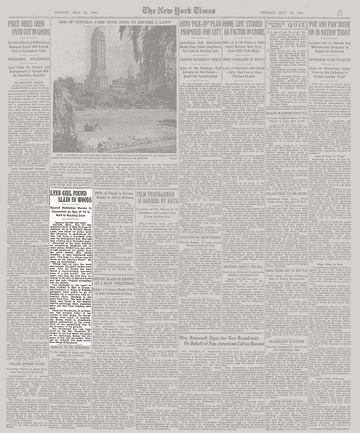
On July 17, 1941, in Lynn, Massachusetts, nineteen-year-old Frances Cochran stepped off a commuter bus and vanished into one of the most baffling unsolved murders in New England history. At least five witnesses watched as she entered a mysterious black automobile — apparently without struggle, apparently without alarm — and was never seen alive again. More than eight decades later, the identity of the driver remains unknown. Cochran had been living and working in the Lynn area that summer. The details of her final afternoon are ordinary in the way that makes them haunting in retrospect — a bus, a sidewalk, an encounter that witnesses at the time had no particular reason to remember as significant. What struck investigators later was the apparent ease of it: Cochran did not appear to resist or flee. The witnesses who watched her climb into the black automobile reported nothing that suggested coercion. Either she recognized the driver, or she had no reason not to trust them. Three days passed. On July 20, 1941, police made a grim discovery in Salem, Massachusetts: the mutilated body of Frances Cochran, found in a secluded area known as a lovers' lane — a spot frequented by couples seeking privacy and, as a consequence, largely shielded from casual observation. The condition of her remains told investigators they were dealing with someone capable of extreme violence. The search for a missing young woman had become a homicide investigation. What followed was one of the most exhaustive manhunts Massachusetts had mounted to that point. Investigators examined approximately twelve thousand automobiles, scrutinizing every vehicle they could connect to the greater Lynn and Salem area in their search for the mysterious black car. They conducted interviews with approximately two thousand witnesses — people who had seen Cochran in the days leading up to her disappearance, residents who lived and worked along the route between the two cities, anyone who might have noticed something. Leads extended across the continent as authorities tried to determine whether the perpetrator had connections beyond New England or whether the crime shared characteristics with similar attacks elsewhere. None of it produced a name. None of it produced an arrest. The case went cold. For investigators of that era, the limitations were profound. There were no DNA databases to search, no centralized repositories of criminal records that could surface patterns across state lines, no surveillance footage to review. Witness memories fade. Physical evidence deteriorates. The investigative techniques of 1941, advanced as they were for their time, could not bridge the gap between what was known — the black automobile, the five witnesses, the lovers' lane in Salem — and who was responsible. Decades later, researchers began examining whether the Cochran murder might be connected to other unsolved killings from the mid-century. Most notably, some have pointed to similarities between her case and the 1947 Black Dahlia murder in Los Angeles, in which the mutilated body of Elizabeth Short was found in a vacant lot. The victims were close in age, the nature of the injuries bore certain resemblances, and the possibility of a mobile perpetrator operating across jurisdictions has been explored. No definitive evidence has ever established a common killer, and the connection remains speculative — but it reflects a broader difficulty with mid-century cold cases: the infrastructure to detect serial patterns simply did not exist when these crimes occurred. The Cochran case has received renewed attention through the work of author Robert Fitzgibbon, who wrote "Murder in Salem, Massachusetts: The Death of Frances Cochran," published by Arcadia Publishing. Fitzgibbon has also discussed the case on the Most Notorious true crime history podcast, drawing on historical records and investigative documents to reconstruct both the crime and the massive investigation that followed. A public talk on the case was held in Gloucester, Massachusetts, drawing audiences still drawn to the unresolved questions at its center. Those questions are not merely academic. Why did Cochran enter the automobile? What happened in the hours between Lynn and Salem? Was the perpetrator someone she knew, or someone skilled at gaining the trust of strangers? Could they have killed again, in Massachusetts or elsewhere, and remained undetected across the decades? The case of Frances Cochran offers no resolution — only the outline of a young woman on a summer afternoon in 1941, the door of a black car closing behind her, and a mystery that five witnesses could not prevent and eighty-three years of investigation could not solve.
1 claim
Not yet independently verified
On the evening of June 29, 1978, the man who had played America's most charming prisoner of war was found beaten to death in a Scottsdale, Arizona apartment. Bob Crane — the easy-grinning Colonel Robert Hogan of "Hogan's Heroes" — was 49 years old. He had been struck repeatedly in the head while he slept, and an electrical cord had been knotted around his neck. The murder weapon was never recovered. Nearly five decades later, no one has ever been convicted of the crime, and the Scottsdale Police Department still carries it on the books as open. Crane had come to the desert the long way around. Born July 13, 1928, in Waterbury, Connecticut, he spent his early career as a fast-talking radio disc jockey before breaking into television. In 1965 he landed the role that would define him: Colonel Hogan, the wisecracking ringleader of Allied prisoners running circles around their captors in a German POW camp. "Hogan's Heroes" ran until 1971 and made Crane a household name, the very picture of wholesome, charismatic American television. The work that followed never matched it. Like many actors whose signature series ends, Crane found the parts thinning out. By 1978 he had moved into theater, and it was a touring dinner-theater production of the comedy "Beginner's Luck" that brought him to Scottsdale, where he was staying in a modest apartment far from the Hollywood life he had once known. He was discovered there by a colleague from the production who had come to check on him — the beginning of an investigation that would stretch across decades and end with no resolution. What investigators uncovered about Crane's private life stood in jarring contrast to his television image. Away from the cameras, Crane had been an obsessive amateur filmmaker of a very different kind, recording and carefully cataloguing his sexual encounters with numerous women. That hidden world widened the field of people who moved through his orbit, and it pointed police toward the man who would become their central suspect. John Henry Carpenter, a video-equipment salesman from California, had befriended Crane through their shared interest in amateur filmmaking. The friendship placed Carpenter squarely inside Crane's private affairs, and investigators came to view him with suspicion. Carpenter had been in Scottsdale on the night of the murder and left quickly the next morning, a detail police found difficult to set aside. But suspicion was not proof, and in 1978 the physical evidence simply was not there. The trail went cold. It was reopened years later by forensics. Re-examining crime-scene photographs taken inside Carpenter's rental car, an examiner identified a small biological stain that had gone unnoticed at the time. That stain became a central element of the prosecution's case, and in 1992 — roughly fourteen years after the killing — Carpenter was arrested and charged with murder. The trial came in 1994. Prosecutors leaned on the forensic stain and on the circumstantial story of the two men's relationship, presenting Crane's secret life to a public that had never known it existed, while arguing that Carpenter's close involvement in that world established his access and motive. The defense pushed back hard on the evidence, questioning its reliability and the chain of custody after so many years had passed. The fundamental problem of a cold case — degraded evidence, faded memories, no recovered weapon — proved decisive. The jury acquitted Carpenter. He maintained his innocence for the rest of his life and died in 1998, carrying whatever he knew with him. The case has never lost its grip on the public imagination. In 2002, director Paul Schrader dramatized Crane's double life and violent death in the film "Auto Focus," with Greg Kinnear in the title role, introducing the mystery to a new generation. But the film, like the trial, offered no answer. With Carpenter dead and acquitted, and with no new suspect ever charged, the question that opened on June 29, 1978 remains exactly where it started: who killed Bob Crane, and why? For Crane's family, who have continued to press for renewed attention to the case, that absence of an answer is the lasting wound. An acquittal is not a finding of innocence, but neither is it a conviction — and the official record holds only that a beloved television actor was murdered in his bed, and that no one was ever held to account. As forensic methods advance, the hope persists that the Scottsdale case may someday give up its last secret. For now, it endures as one of Hollywood's most stubborn unsolved crimes.
In the pre-dawn dark of July 10, 2016, a 27-year-old Democratic National Committee staffer named Seth Rich was walking home through the Bloomingdale neighborhood of Washington, D.C., when he was shot twice in the back. It was roughly 4:20 in the morning. He was close to home. According to the District's Office of the Chief Medical Examiner, he died about an hour and a half later. A decade on, no one has been charged, and the case remains officially open — a genuine unsolved homicide that, in the vacuum such crimes leave behind, was seized upon and rebuilt into one of the most corrosive political conspiracy theories of the era. Rich was not a household name before that morning. He worked at the DNC as a data analyst — the kind of behind-the-scenes digital and data role that fills the offices of a national party. He lived in Bloomingdale, a residential quarter of the capital known for its concentration of young people building careers in politics. By every account of his colleagues, he was a dedicated staffer, absorbed in the unglamorous machinery of getting people registered and out to vote. The physical evidence at the scene told an ordinary and sad story. Rich's watch, his wallet, and his phone were reported to be still on him when he was found. The Metropolitan Police Department has investigated the killing as consistent with a botched robbery — an attack that turned deadly before anything was taken. That reading fit the neighborhood's pattern of late-night street crime. But the same details that pointed police toward a robbery gone wrong would later be twisted into "proof" of something far more sinister, precisely because nothing had been stolen. The timing was the accelerant. Rich died months before the 2016 presidential election, during the exact window when leaked internal DNC emails were roiling the campaign. Within weeks, a theory took hold across social media and parts of the political press: that Rich, not Russian hackers, had been the source of those emails, and that he had been murdered to silence him. It was a narrative built entirely on coincidence and insinuation — a young DNC employee, an unsolved death, a leak — with no evidence tying any of those threads together. Every serious investigative finding cut against that story. In July 2018, the U.S. Department of Justice indicted 12 officers of Russia's military intelligence directorate, the GRU, charging them with hacking the email accounts and networks of Democratic Party officials, including the DNC itself. The U.S. intelligence community — the CIA, FBI, and NSA — had already concluded that the leaked emails were part of a coordinated Russian campaign to interfere in the election. The technical and forensic record pointed to a foreign state operation, not to a data analyst with a login and a grievance. None of that stopped the theory from spreading, and some of the loudest amplification came from Fox News, which promoted the false claim that Rich had been involved with the leaks and killed over them. The consequences fell hardest on the people with the least defense against them: his family. His parents, Mary Rich and Joel Rich, spoke out repeatedly against the speculation, describing the added anguish of watching their murdered son turned into a political prop. They demanded a formal retraction and apology from Fox News, and they sent a cease and desist letter to Rod Wheeler, a private investigator the network had featured in its coverage. The case sits at an uncomfortable intersection that true-crime readers will recognize. Here is a real, still-unsolved murder — a young man shot in the back a block from his door, his killer never found — layered over with a fabricated story so loud it nearly buried the actual crime. The robbery-gone-wrong that police describe is mundane and grim in the way most street homicides are. The conspiracy is baroque and, on the evidence, false. Ten years later, the honest account is also the plainest one. Seth Rich was killed on a Washington street in the early hours of July 10, 2016. The crime has not been solved. The elaborate theories that attached themselves to his death have been contradicted by federal indictments and intelligence findings alike, and the people who knew and loved him have spent years asking only that his death be treated as what it was — a loss, and an open question for investigators — rather than raw material for someone else's argument.
1 claim
Not yet independently verified
1 claim
Not yet independently verified