Lizzie Borden Acquittal

closedUS

0 verified · 0 unverified · 1 claims total

On the afternoon of June 20, 1893, the jury in New Bedford, Massachusetts filed back into the courtroom after deliberating for little more than an hour. When the foreman rose to deliver the verdict, the answer was not guilty. Lizzie Borden walked out of that courtroom free, and the question of who killed Andrew and Abby Borden has never been officially answered.

The story had begun ten months earlier, on August 4, 1892, at the Borden family home on Second Street in Fall River, Massachusetts. Andrew Jackson Borden, a successful businessman, had returned from morning errands and fallen asleep on the living room settee. He was found there, murdered — struck multiple times in the face and head with an axe or hatchet. Upstairs in the bedroom, his wife Abby Gray Borden had already been killed in the same manner. The wounds on both victims were severe and consistent with the same weapon, leading investigators to conclude that a single killer had moved deliberately through the house.

Lizzie Andrew Borden, born in Fall River on July 19, 1860, was Andrew's younger daughter. Her biological mother, Sarah Anthony Morse, had died when Lizzie was barely three years old, and her father had remarried Abby Gray. By the time of the murders, Lizzie reportedly referred to her stepmother simply as "Mrs. Borden" — a detail investigators seized upon as evidence of a household at odds beneath its respectable surface.

When police arrived that August morning, Lizzie was the only family member home. Her account of events was inconsistent in places. She had allegedly been seen burning a dress in the kitchen stove in the days after the killings. A hatchet head without its handle was recovered in the basement. These details formed the skeleton of the prosecution's circumstantial case.

The trial was moved from Fall River to New Bedford to secure a more impartial jury, away from the intense local coverage that had consumed Bristol County for months. For approximately two weeks, witnesses testified about the timeline of that August morning, the physical evidence found at the scene, the strained relationship between Lizzie and her stepmother, and the inconsistencies in Lizzie's own statements. Journalists packed the gallery and filed dispatches for newspapers across the country. The prosecution argued that the absence of any other plausible suspect, combined with Lizzie's behavior before and after the murders, pointed to her guilt. The defense countered that the entire case rested on circumstantial inference and invited the jury to consider other possibilities.

The jury retired at 4:20 in the afternoon on June 20, 1893. They returned after roughly an hour and twenty minutes — a speed that stunned observers who had anticipated days of deliberation. The acquittal was complete and unconditional.

No other suspect was ever formally charged with the murders. The case was effectively closed the moment Lizzie walked free.

She returned to Fall River and lived there for the rest of her life, eventually moving with her sister Emma to a more fashionable neighborhood. She did not marry. Over time, the sisters became estranged, and Emma eventually moved out separately. Lizzie died of pneumonia on June 1, 1927, at the age of sixty-six. Emma died nine days later, on June 10, 1927.

The folk rhyme that grew up around the case — "Lizzie Borden took an axe, gave her mother forty whacks" — outlasted everyone involved. It contains inaccuracies: Lizzie was acquitted, the weapon details are debated, and Abby was her stepmother, not her mother. None of that has slowed its circulation through more than a century of American popular culture. The murders, the trial, and the eighty-minute verdict have been revisited in stage plays, novels, films, and dozens of true-crime retrospectives, each drawn back to the same unresolved center.

What endures is not just the mystery but the question beneath it: what did it take, in 1893, to convince a jury that a Sunday-school-teaching daughter from a respectable Fall River family was capable of this? The prosecution built its case on motive and opportunity. The defense built one on image and reputation. The jury deliberated for eighty minutes and chose the image. Whether they chose correctly is a question history has spent 133 years failing to settle.

Images

Archival and public-source images gathered for this case, shown as found and marked unverified until a human checks rights and relevance. Not a rights clearance, endorsement, or complete record.

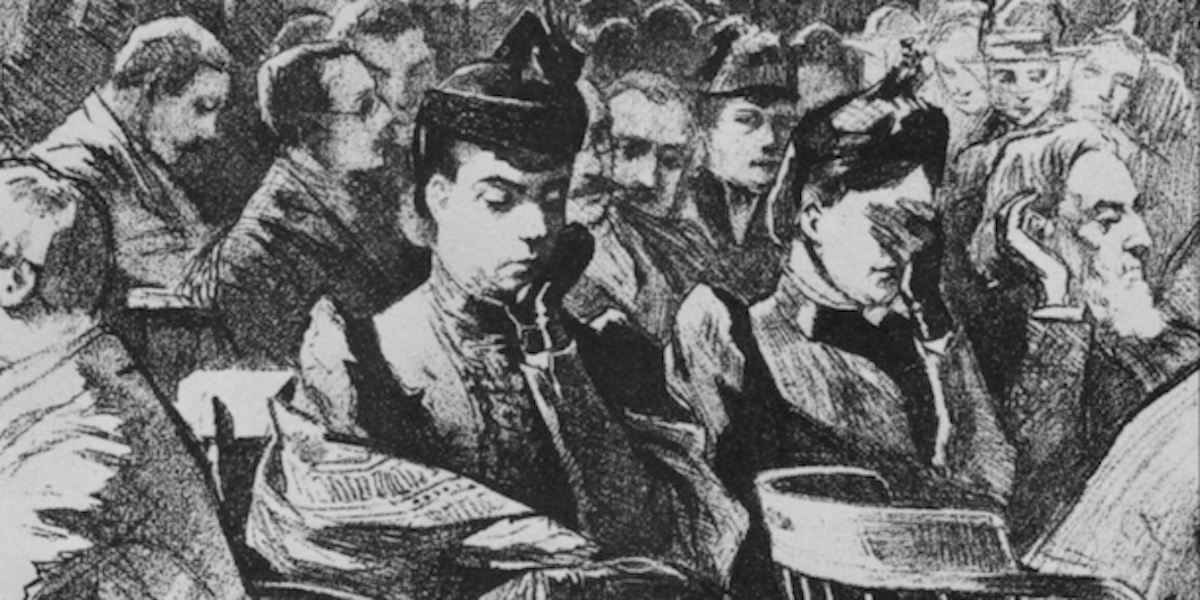
The Borden murder trial—A scene in the court-room before the acquittal - Lizzie Borden, the accused, and her counsel, Ex-Governor Robinson. Illustration in Frank Leslie's illustrated newspaper, v. 76 unverified
BW Clinedinst, the Borden murder trial cph.3c23237.jpgBenjamin West Clinedinst
Title: The Borden murder trial--A scene in the court-room before the acquittal - Lizzie Borden, the accused, and her counsel, Ex-Governor Robinson / drawn on the spot by B. West Clinedinst. Abstract/munverified
The Borden murder trial-A scene in the court-room before the acquittal - Lizzie Borden, the accused, and her counsel, Ex-Governor Robinson - drawn on the spot by B. West Clinedinst. LCCN99403183.jpgClinedinst, B. West (Benjamin West), 1860-1931, artist
The Borden murder trial—A scene in the court-room before the acquittal - Lizzie Borden, the accused, and her counsel, Ex-Governor Robinson. Illustration in Frank Leslie's illustrated newspaper, v. 76 unverified
Lizzie Borden by B.W. Clinedinst.jpgB.W. Clinedinst
1 photomechanical print : halftone.unverified
The Borden murder trial--A scene in the court-room before the acquittal - Lizzie Borden, the accused, and her counsel, Ex-Governor RobinsonLibrary of Congress, Prints & Photographs Division
Lizzie Borden Acquittal — archival photounverified
Lizzie Borden Acquittal — image 7
Lizzie Borden Acquittal — archival photounverified
Lizzie Borden Acquittal — image 8
Lizzie Borden Acquittal — archival photounverified
Lizzie Borden Acquittal — image 9
Lizzie Borden Acquittal — archival photounverified
Lizzie Borden Acquittal — image 10
Lizzie Borden Acquittal — archival photounverified
Lizzie Borden Acquittal — image 11